Saturday, March 24, 2012

A nice sail

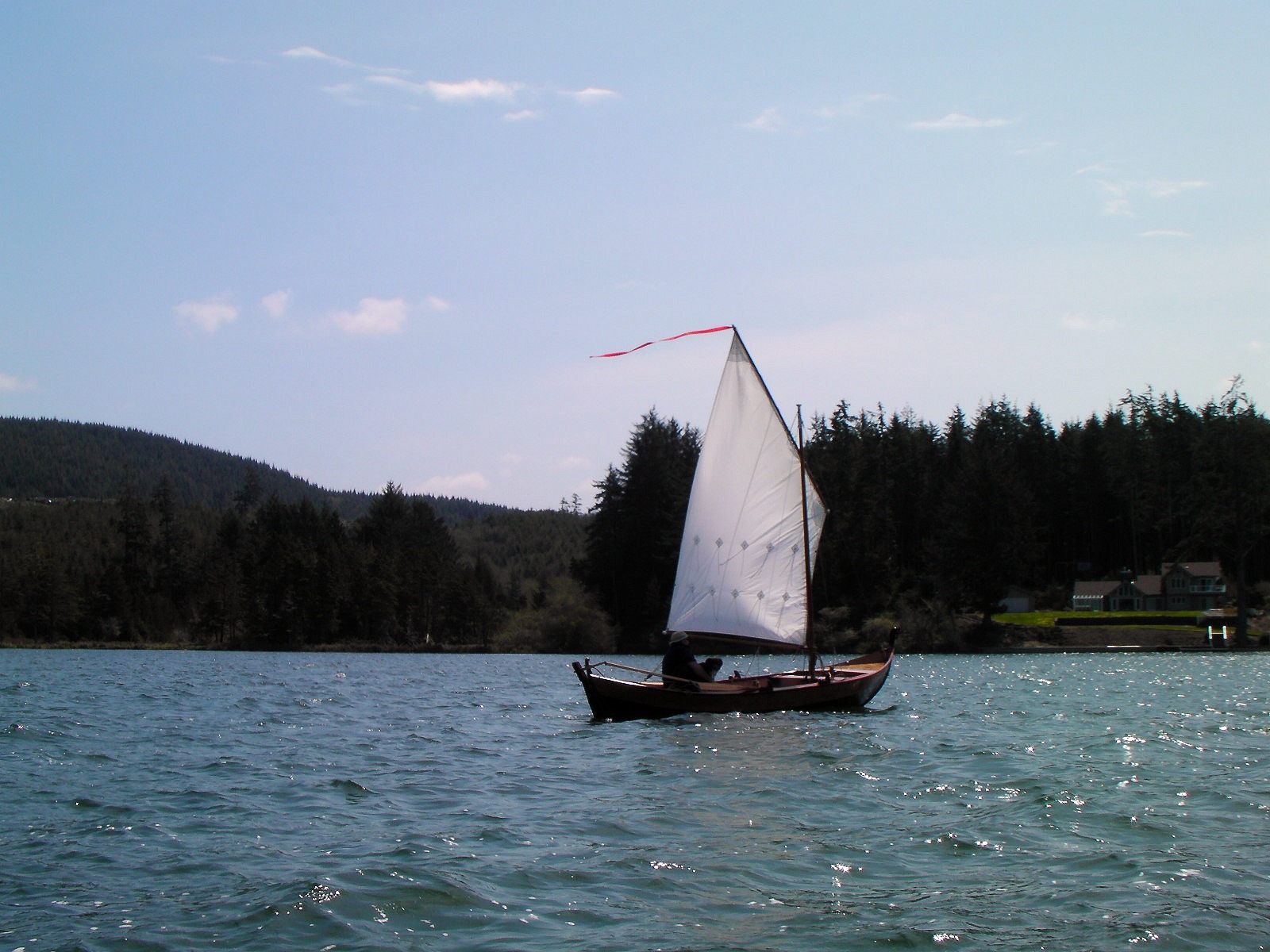
Trouble the Sailor Dog and I went for a sail yesterday on our local lake. The day was just too beautiful to resist.


You'll notice that Trouble took her ease on the foredeck, which didn't work out so well for her. In the later photos you may also notice she looks a little damp. One of the nice things about Ravn is she is roomy enough for a wet dog to shake off gallons of water while the helmsman stays perfectly dry.

The winds started out nice and steady from the northeast, then died completely. I spent some time drifting aimlessly thinking it is a perfect metaphor for my life recently. Then the winds filled in from the southwest and Ravn came back to life. Perhaps I will find new direction with a change too.

Friday, March 9, 2012

Prudent, or just a chicken?

Devil's Lake looks deceptively placid. It's blowing like stink!
After what seems like weeks of cold, rainy weather we got a little sun. All day yesterday I was wishing I wasn't at work so I could take Ravn out. Today wasn't supposed to have any sun, but by late morning it broke through and I hitched up the boat. What was a nice breeze at my house turned into fairly strong wind at the boat launch that's five minutes away. Nevertheless, I stepped the mast, tied the halyard to the spar and put the oars through the humlibands in preparation to launch.

As I was walking to the truck to launch, I got hit with a 40-knot gust. I hesitated; weighing my feelings. Was it fear I was feeling, or instinctive warning that one ignores at one's peril? I guess I will never know: I unstepped the mast, strapped my little faering down and headed for home.

The one job I've been putting off is leading some lines to make reefing easier. Maybe if I had those in place I could have tied a reef or two in and had a great sail. One more thing on the to-do list. I really hate being a fair-weather sailor.


I did get some good photos of the newly-served humlibands while they were out in the sunshine.

It is now four hours later and the clouds are back. The sun is gone. Again.

Oars finished


I finished Ravn's second pair of oars back in October, but I'm just now getting around to posting about them. I'm a happier with the look and balance of this second set. (They are the lighter-colored pair on the right.) So I carved a little more on the older pair and now I'm pretty happy with them too. I used several coats of my oil-varnish-mineral spirits mixture. It seems to work well and is very easy to repair and maintain.

Now that I have four oars that match I need to recruit three more rowers to reenact the experiment at the Toledo Wooden Boat Show.

Thursday, February 16, 2012

Kjeip, kabe -- by either name they are cool!

I've already talked about kabes or kjeips on the blog before, but not since I installed them. I've rowed with them now for more than a year and I really like them.

I'm applying Stockholm tar to the gasket before serving.
Last week I made a little change, not to the kjeips themselves, but to the rope gasket that keeps the oars in place when you're not pulling on them. These have a Norse name, but I can't remember what it is... h-something. Anyway, they were originally made of plaited spruce roots, which would make them tough and stiff.

At first, I made mine out of quarter-inch synthetic hemp rope and tied it with a Zeppelin bend. I adjusted the size of the loop during several rows until I found the ideal size the gasket needed to be. Then, I laid up the four rope gaskets with 5/16ths synthetic hemp (made of polypropylene). Laying up the rope gasket was a little tricky because I had to work it through the hole in the kjeip and it was a pretty tight fit.

I liked the rope gaskets: They looked good and worked well except -- and this was almost a deal breaker -- two of the four developed a figure-eight twist in them that caused the gasket to work its way between the oar and the kjeip. It caused a ker-thunk, ker-thunk, ker-thunk every time you pulled on the oar. It about drove me crazy!
Here is the served gasket with the oar in place.

So last week I served the gasket with some light hemp rope. Since hemp will rot if it stays wet, I coated the gasket with Stockholm tar as I was serving it and then worked some of the tar into the hemp fibers. I love the way it smells. Nothing says traditional rigging like Stockholm tar.

Serving the gasket increased the stiffness enough so it stays proud of the oar and the kjeip and doesn't get caught between them. It will also protect the rope gasket from chafe.

One of these days I'm going to get around to harvesting some spruce roots and do it up right; but for now, this will serve.

Also this week, my friend, Giacomo De Stefano, posted some beautiful photos from the Viking Ship Museum in Roskilde, Denmark. Among the group of photos are some wonderful pictures of kjeips.

This one just about stopped my heart when I saw it. Beautiful!

This is a Hardanger Fjord-style kjeip. Made for oars with a square loom.

Here are some kjeips being made.

Friday, January 20, 2012

The Best Wife Ever!

That's right bitches, I'm married to the most amazing woman on the planet. Eat your heart out.

My wife calls the sock that fits over the dragon head the "hostage hood."
Even though she lives in another state, my wife was able to make a pattern (with the help of Doryman's wife, Mary), buy exactly the right acrylic canvas (perfect color too), sew a huge cover that was almost a perfect fit the first time we tried it on, and put it under the Christmas tree and make it a complete surprise to me. I must admit, surprising me about anything is not a great feat; I usually have my head in the clouds (the less charitable would say another place). But the rest of it was impressive: this cover is truly a work of art!

I knew I wanted and needed a cover for the boat, but I had no clue how it could be done. My wife designed the cover so well that I can put the hood over the dragon head, unroll it the length of the boat and put a smaller hood over the stern stem and the cover is stretched perfectly down the middle. Then it's a simple matter to tie it down and I'm ready to hit the road. The stitching is very professional, even though she often had to sew through three and four layers of fabric. There are no raw edges anywhere.

The only thing I can take credit for was setting a few grommets, which is a pretty fun job.

I had an acrylic canvas cover on my Chamberlain dory that worked perfectly (also made by my wife). It was in very good shape when I sold the boat after eight years of service -- all of it outdoors. It looked like it could have easily made it another eight or 10 years.


Here's hoping this one will last as long, because it is a thing of beauty, like my wife.

Monday, January 2, 2012

Kelly wants to build a faering

I need more tension on the luff, but it was my second sail.
Kelly, from Kerrville, Texas, is thinking about building a faering to sail and row primarily in a wide, deadwater river area with submerged cypress stumps. He wrote me with a couple of questions.

"I believe the length of Atkin's plan is preferable to 16'6'' in Oughtred's Elfyn design. However, Atkin's plan is described as finishing at 600 lbs.  Understanding that includes lead ballast, more meat in the keel, and so on, I'm concerned about draft.  Oughtred's plan says it finishes around 150 lbs."
A friend of mine, John Kohnen, told me Atkin said in one article the boat would weigh 600 pounds. In another he said it should weigh 450. I need to find a truck scale near a place with a boat ramp so I can weigh mine. My guess is that it would be closer to 450. Although I'm a belt and suspenders kind of builder who tends to overbuild things, I tried to rein myself in during Ravn's construction.

The design calls for 106 pounds of lead in the keel and I put in 98 pounds, according to my bathroom scale. I used purple heart wood for the keel, which is pretty heavy and with my tendency to overbuild, I thought I'd knock off a few pounds so I wouldn't come in too heavy. As far as I can tell, she floats right on her lines, so I think I succeeded.

I would not leave out the lead. The lines of the Valgerda are, according to Atkin, taken right off a Hardanger Fjord faering. Traditional boats built with modern methods (stitch and glue or glued lapstrake) usually end up lighter than the original. I think this would be true of Valgerda. If she didn't have the additional lead in the keel, you would have to add ballast inside to bring her down to her lines. I don't like the idea of lead pigs (or rocks) sliding around in the bilge. Were I to have inside ballast, I think I'd use sand bags, but that would be a hassle too.
I made the keel six inches shallower than on the plan making the draft about 12 inches instead of 18. I also gave her a little more skeg than Atkin drew. My reasons for these changes were these: I wanted shallower draft to make her easier to get on and off a trailer and because my primary cruising grounds include the beautiful coastal rivers of Oregon. The shallow bars require a shallow draft and good directional stability when you are on top of a wave (hence the increased skeg area). Beaching is easier too with less keel. Another possible advantage is a little less wetted surface, which would make her easier to row and may provide a little advantage in light air.

The only down side to the changes is that the deeper keel that Atkin drew should - theoretically - go to windward better. If you want a boat that you can tack upwind in a narrow channel, Valgerda is not your girl, even with the deeper keel configuration. In that situation, I drop the sail and row. That said, I am happy with my boat's windward performance: she is close winded, won't stall in a tack if you have enough way on and the right tension on the luff rope, and if she makes any leeway it's too little to notice.

An East Coast builder, Rick Nardone, built a Valgerda about the same time I built Ravn. He eliminated Atkin's fin keel too, opting to return to the more traditional faering keel, which is about four inches deep. His boat draws about 10 inches. Rick's been a real busy guy and I've only received one rowing report from him, so I don't know how she sails. That's another approach you might consider. (I think his boat may be for sale, by the way, if you want to skip the hassle of building a boat.)

I agree with you that Oughtred's faerings seem short. Modern Norwegian faerings are 18 or 19 feet long and the older ones, like the one buried with the Osberg ship, were more like 22 feet. Oughtred's  
Arctic Tern and Ness Yawl designs are the length I would consider, but there's something I really like about the three-strake faerings.

If, however, you decide you want something lighter or with a centerboard, by all means go with an Oughtred design. They are beautiful boats and, by all accounts, stellar performers. DO NOT put a centerboard in the Valgerda. I think that would really mess the boat up for little gain and a lot of unnecessary complication.
"Also, I'm curious as to whether or not you considered building in solid wood. After pursuing many boatbuilding sites now, I nearly have the impression that building a traditional craft in traditional style is less work than modern plywood and epoxy.  Not that simple, I'm sure."
By no means is building in solid timber easier. It takes more esoteric skill, is less forgiving and materials are harder to come by. (To build Valgerda, for instance, you would need board 22-inches wide and about 20 feet long for the mid-plank. Good luck finding that!) Then, once you have her built, the fun really begins. A traditionally-built faering needs to spend its life in the water or out of the sun and dry wind in a boat shed. Keeping a traditionally-built faering on a trailer - especially in a dry, hot place - would simply kill it.

Adrian Morgan, a boatbuilder in Scottland, built an all-wood version of one of Oughtred's faerings. Check out his blog and web site.
  
Now, about Kelly's shallow lake with sumps: I built my boat with just such conditions in mind. Where I sail there are lots of rocks just under the surface and plenty of deadheads too. I haven't had any collisions yet, but I put a double layer of 6-ounce fiberglass cloth below the waterline and built my keel and stems extra tough out of purple heart. I'm confident she could take a pretty good hit.
I don't think Kelly could go wrong with Valgerda or an Oughtred design. I told him another design he might consider is the Sellway-Fisher Kari 2.

The important thing is to build one. I hope I can post photos of his progress here soon. The world needs more faerings!

Saturday, November 19, 2011

November sail

Trouble the Sailor Dog on watch.
I was hoping Saturday would provide a break in the storms that hammered the coast this week and I got my wish. The rain and winds abated leaving filtered sunshine and a light breeze in their wake.

Devils Lake is only a few minutes from my house. It's a beautiful lake and I had it all to myself, unlike during the summer. The north wind was light but steady, giving me a chance to further explore Ravn's windward ability. With the proper amount of luff tension she goes to windward just fine thank you. No racing dingy, but she will make progress to windward.

She's well behaved on other points of sail as well. Ghosting down wind, Trouble the Sailor Dog and I got close to  a large flock of ducks who were using the lake as a rest stop before flying farther south.

Made the dock without touching the oars.
As the sun set I headed for the dock. The wind all but died as I passed a point to windward and Ravn ghosted alongside the dock.

Trouble and I stepped off with no fuss or muss to an audience of none but waterfowl. Where are the people when you do something slick?