Showing posts with label Valgerda. Show all posts

Monday, January 2, 2012

Kelly wants to build a faering

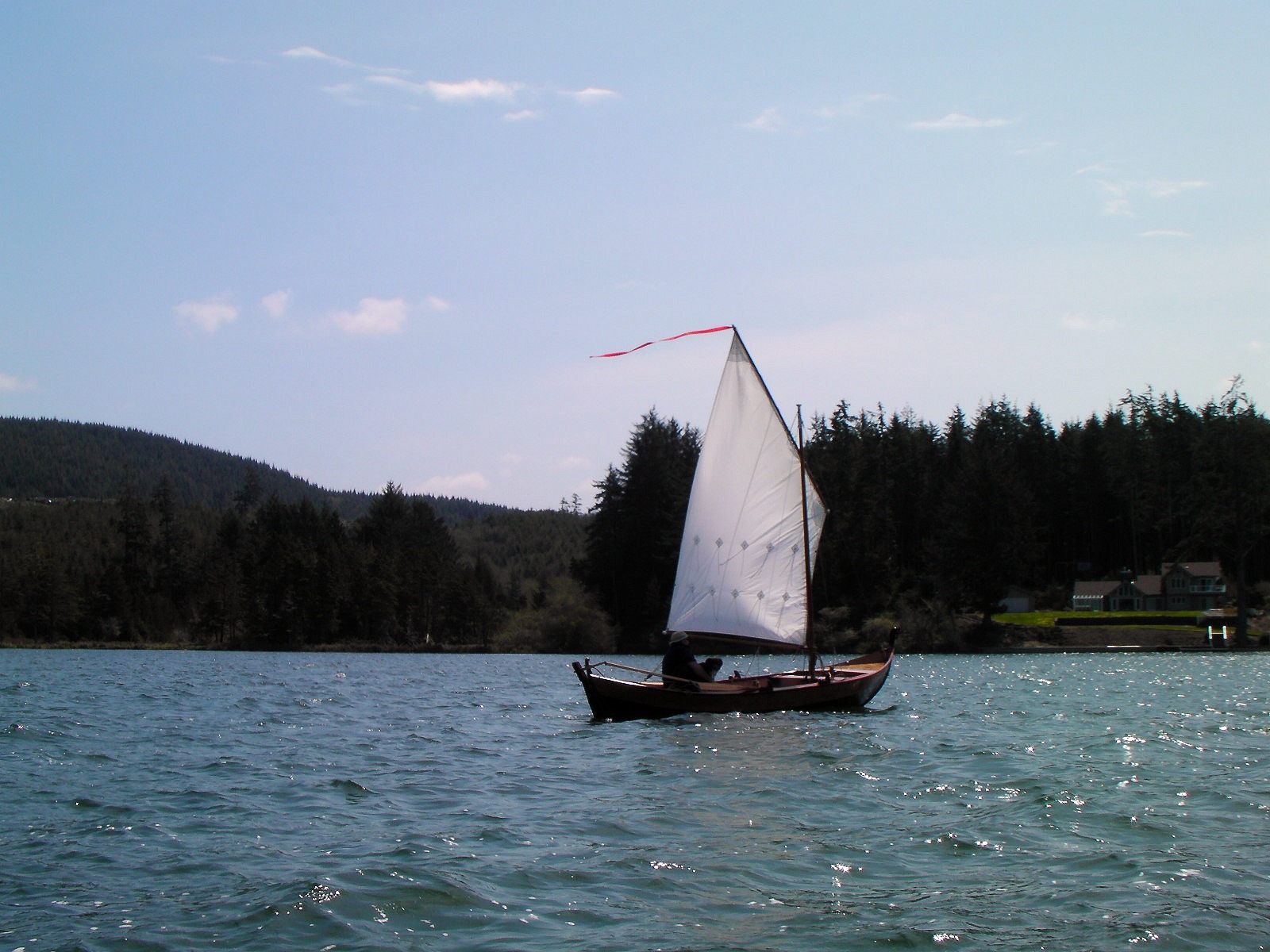
I need more tension on the luff, but it was my second sail.
Kelly, from Kerrville, Texas, is thinking about building a faering to sail and row primarily in a wide, deadwater river area with submerged cypress stumps. He wrote me with a couple of questions.

"I believe the length of Atkin's plan is preferable to 16'6'' in Oughtred's Elfyn design. However, Atkin's plan is described as finishing at 600 lbs.  Understanding that includes lead ballast, more meat in the keel, and so on, I'm concerned about draft.  Oughtred's plan says it finishes around 150 lbs."
A friend of mine, John Kohnen, told me Atkin said in one article the boat would weigh 600 pounds. In another he said it should weigh 450. I need to find a truck scale near a place with a boat ramp so I can weigh mine. My guess is that it would be closer to 450. Although I'm a belt and suspenders kind of builder who tends to overbuild things, I tried to rein myself in during Ravn's construction.

The design calls for 106 pounds of lead in the keel and I put in 98 pounds, according to my bathroom scale. I used purple heart wood for the keel, which is pretty heavy and with my tendency to overbuild, I thought I'd knock off a few pounds so I wouldn't come in too heavy. As far as I can tell, she floats right on her lines, so I think I succeeded.

I would not leave out the lead. The lines of the Valgerda are, according to Atkin, taken right off a Hardanger Fjord faering. Traditional boats built with modern methods (stitch and glue or glued lapstrake) usually end up lighter than the original. I think this would be true of Valgerda. If she didn't have the additional lead in the keel, you would have to add ballast inside to bring her down to her lines. I don't like the idea of lead pigs (or rocks) sliding around in the bilge. Were I to have inside ballast, I think I'd use sand bags, but that would be a hassle too.
I made the keel six inches shallower than on the plan making the draft about 12 inches instead of 18. I also gave her a little more skeg than Atkin drew. My reasons for these changes were these: I wanted shallower draft to make her easier to get on and off a trailer and because my primary cruising grounds include the beautiful coastal rivers of Oregon. The shallow bars require a shallow draft and good directional stability when you are on top of a wave (hence the increased skeg area). Beaching is easier too with less keel. Another possible advantage is a little less wetted surface, which would make her easier to row and may provide a little advantage in light air.

The only down side to the changes is that the deeper keel that Atkin drew should - theoretically - go to windward better. If you want a boat that you can tack upwind in a narrow channel, Valgerda is not your girl, even with the deeper keel configuration. In that situation, I drop the sail and row. That said, I am happy with my boat's windward performance: she is close winded, won't stall in a tack if you have enough way on and the right tension on the luff rope, and if she makes any leeway it's too little to notice.

An East Coast builder, Rick Nardone, built a Valgerda about the same time I built Ravn. He eliminated Atkin's fin keel too, opting to return to the more traditional faering keel, which is about four inches deep. His boat draws about 10 inches. Rick's been a real busy guy and I've only received one rowing report from him, so I don't know how she sails. That's another approach you might consider. (I think his boat may be for sale, by the way, if you want to skip the hassle of building a boat.)

I agree with you that Oughtred's faerings seem short. Modern Norwegian faerings are 18 or 19 feet long and the older ones, like the one buried with the Osberg ship, were more like 22 feet. Oughtred's  
Arctic Tern and Ness Yawl designs are the length I would consider, but there's something I really like about the three-strake faerings.

If, however, you decide you want something lighter or with a centerboard, by all means go with an Oughtred design. They are beautiful boats and, by all accounts, stellar performers. DO NOT put a centerboard in the Valgerda. I think that would really mess the boat up for little gain and a lot of unnecessary complication.
"Also, I'm curious as to whether or not you considered building in solid wood. After pursuing many boatbuilding sites now, I nearly have the impression that building a traditional craft in traditional style is less work than modern plywood and epoxy.  Not that simple, I'm sure."
By no means is building in solid timber easier. It takes more esoteric skill, is less forgiving and materials are harder to come by. (To build Valgerda, for instance, you would need board 22-inches wide and about 20 feet long for the mid-plank. Good luck finding that!) Then, once you have her built, the fun really begins. A traditionally-built faering needs to spend its life in the water or out of the sun and dry wind in a boat shed. Keeping a traditionally-built faering on a trailer - especially in a dry, hot place - would simply kill it.

Adrian Morgan, a boatbuilder in Scottland, built an all-wood version of one of Oughtred's faerings. Check out his blog and web site.
  
Now, about Kelly's shallow lake with sumps: I built my boat with just such conditions in mind. Where I sail there are lots of rocks just under the surface and plenty of deadheads too. I haven't had any collisions yet, but I put a double layer of 6-ounce fiberglass cloth below the waterline and built my keel and stems extra tough out of purple heart. I'm confident she could take a pretty good hit.
I don't think Kelly could go wrong with Valgerda or an Oughtred design. I told him another design he might consider is the Sellway-Fisher Kari 2.

The important thing is to build one. I hope I can post photos of his progress here soon. The world needs more faerings!

Friday, February 25, 2011

Questions from Victor and an Offer to Followers

Here's a shot of Ravn's bow before I turned her over. Notice the hollow entry and flare in the bow. When I was lofting the O station I almost messed this up. But I caught the mistake in time.

I started to answer a question from a reader and got a little long, so I decided to make a post of it. Victor writes:

I am seriously considering building a Valgerda. I think this boat is one of the most beautiful and authentic looking faerings around, (apart from the traditionally built ones of course!). Unfortunately building one (traditionally) with solid lumber is not an option for me.

I am a bit apprehensive about all that lofting. Which reminds me, both you and Rick Nardone mention an error with Mr Atkin's offsets , can you elaborate on this please? Did you find that the offsets given were relatively close after fairing the lines?

Is this boat "a handful" to row?

-Victor

Dear Victor,

I hope you do build a Valgerda. They are wonderful boats and rowing one is almost a religous experience.

While I don't consider myself an expert rower, I have rowed a lot of different boats and Ravn is far and away my favorite. She is a big boat, but far from being a handful to row, she is very well behaved. One person can row her with no problem. She tracks like she's on rails and has the good sense to punch through the small waves and ride over the big ones. I built her so she could cross the shallow river bars we have on the Oregon coast and she does that like a pro.

She does not handle like a light, flat-bottomed boat -- don't expect to do a 360 in her length -- but you also won't get dumped off a breaking wave and broach like happened to me in my little dory.

Both Rick Nardone and I built the keel different from the plans. My keel is 6 1/2-inches deep, which makes my boat draw about 12 inches. Rick's is about four inches, with a total draft of about 10 inches. The keel Mr. Atkin drew is more than 18 inches, which would pose a problem launching and recovering her from a trailer. I find Ravn to be very handy in that respect. She isn't much more difficult to launch and recover than my little 13-foot, 150-pound Chamberlain dory.

Now about the lofting: Rick said the lofting was easy and a good project for a beginner. He's a professional boat builder and knows what he's doing. This is the first and only boat I've ever lofted so it was a bit of a challenge for me, but only because I'm not good at all with numbers. I found Mr. Atkin's table of offsets to be right on the money as far as I could tell.

The mistake I made was by not following exactly the lofting of the 0 and 12 station (the first and last ones). It didn't look right to me because it tucked in more than I thought it should so I modified it. Once I set up the stations I saw my mistake and corrected it with no harm done. Had I not fixed the mistake, Ravn wouldn't have the beautiful hollow entry she has.

The Offer
I found it was easier for me to make up my own table and translate the traditional feet-inches-and eighths into exactly what that looks like on a tape measure. I know, it's kindergarten stuff, but, like I said, I'm not a numbers guy. I have that as a doc. file and would be happy to sent it to any of those who follow this blog if they can prove they have already purchased the plans from Mrs. Atkin. The plans are a beautiful piece of art. If you are building this boat you need to have them. Besides, I wouldn't want to cheat Mrs. Atkin. At $50 the plans for Valgerda are a bargain. She is providing a great service making the Atkin plan catalog available to boat builders.

Tuesday, February 8, 2011

Tim Mooney's experience with Valgerda

There is a great post from the archives of the Wooden Boat Forum, Sept. 21, 2004, by Tim Mooney . He talks about the Valgerda that he built:

"Well, here's what I think. I built one of these Valgerda boats, and sailed it from Mystic to Annisquam, MA; up the coast of Maine and in the Great Lakes. I lived aboard for up to six weeks at a time and I think the boat is great. The rig is great. and the ballast is great. No you don't row this boat to windward. No you don't want to sail her unballasted (flotation is a good idea).
This is the driest small boat I've ever been on. I know why the Norwegians use the verb swims, as in "she swims well," to describe their craft; if you get wet sailing to windward in under 15 knots of wind in open water it is because of gross inattention misdirecting the tiller. Normally she seems to try to attack waves like she knows where she wants to go and the spray stays down low. The rig may not look like much to you, but sailing I liked it. I added 8" to both luff and leach and had two deep reefs; wouldn't change anything else. I wouldn't want a less high aspect sail, since I like getting to weather.

"Since there is a keel and the center thwart is not structural, I'd take it out, stick it in the back with the furled rig, the oar that wasn't holding up my tent and live with a big comfortable space. I could go on. I love this boat. I had the most fun of my life with her."

April 1, 2011
I did ask Mr. Mooney if I could post this before I actually posted it, no foolin'. The thing is, I didn't hear back from him for some weeks, so I went ahead and posted it anyway.

Lucky for me that I received the gracious email a couple of days ago: "No problem using my old forum post. I sometimes think of writing more about the boat. -- Tim Mooney"

I immediately wrote back thanking him and asking for more recollections of his Valgerda and photos. Here's hoping!

Friday, February 4, 2011

Other Valgerdas

Doryman's Valgerda at the Toledo Wooden Boat Show last August.

I correspond regularly with two other Valgerda owners - Doryman, who lives just down the coast, and Rick, who lives on the other coast - and I'd like to add to the list.

There must be more; the design has been around since 1952. John Kohnen snapped a few pictures of two different Valgerdas at recent Port Townsend Wooden Boat Festivals. I also saw one for sale on the East Coast a few years ago. It would be nice to have a list of builders, owners or former owners.

Heck, I'd even like to talk to folks who have just sailed or rowed one. Or even people who are thinking of building one.

I'd also like to talk to owners and builders of Kari 2, the Selway-Fisher faering of about the same size and style. I own a set of plans for this boat and almost built it, but the Atkin plan won out.

So, if you fit any of the above categories please let me know through the comment section of this blog. I would like this to be a place where we can share stories and ideas about this great design.

Rick's Valgerda

Saturday, January 15, 2011

New Year's Row

Ravn and Paku waiting to be loaded onto trailers.

I know I'm a little slow on this post - like two weeks - but I need to write it so I can write the post I really want to write.

My wife and I had an enjoyable, but cold, row on New Year's Day. It was another drift down the Yaquina River. This time my wife didn't have to work so she was able to occupy the princess seat. In stead of a full codgery of Coots, only one other vessel accompanied us: Doryman and his wife, Mary, rowed their beautiful Culler skiff Paku.

Mary and my wife have many similar interests (yarn, knitting, violins and other stuff). Doryman and I often get together to "play boats" with his fleet of small craft. The Doryman has only about seven boats at the moment, but that number can and does change with alarming frequency. All his boats are made of wood and have either been extensively restored or built from scratch by Doryman. Some are even his own designs. If that weren't enough, he is also the current international president of the Traditional Small Craft Association.

In all, an interesting couple. Needless to say, we did a lot more talking than rowing. That was OK, however, because Doryman planned the outing so the ebb tide and the river's current gave us a two-knot, or better, push down the river. How could an outing like this get any better? Food and even more conversation, which is how we ended the day in a great little BBQ restaurant in Toledo. Thanks Mary and Doryman!

Saturday, September 12, 2009

Valgerda or Kari?


The plans arrived from the Atkin Co. in November 2004. I had a lot of work to do to get my shop to where I could accommodate building a 19-foot boat and other projects that needed finishing. While I was working on those other things I studied the plans, built models of Valgerda and fretted about how I was going to build her.
Atkin designed Valgerda in 1952 taking the lines off of a faering imported from Norway. He praised the workmanship and design of the faering that was the inspiration for his design. The only thing he changed was the keel. He said: "I designed a new keel - the original boats had a long, shallow keel approximately 4 inches deep. When loaded, they had sufficient lateral plane to hold the little craft on the wind. With expert handling, they had little difficulty in reaching port." He drew a shallow ballast keel that housed 106 pounds of lead. The other change he suggested in building the faering was that marine plywood be used for the planking since 20-inch wide pine planks are hard to come by.
As my list of projects in the shop diminished, my doubts about whether I'd chosen the right design grew. Then I found another faering, this one was designed Selway-Fisher firm in England. The lines for this design were taken from a historic 1892 boat that now resides in a museum. It was designed for "stitch and glue" construction, which appealed to me also.
In the Selway-Fisher catalog it says of the Kari 2: "The original (was) built in 1892 for the sum of 70 Kroner (£3.10.0). The original is now in a museum and still in excellent condition, having been used by several generations for holidays and a few long expeditions. We have now taken the original lines and produced construction drawings for modern stitch and epoxy construction using plywood. The hull is a close resemblance of the original but we have given her a deeper keel to enhance her windward performance."
I ordered the plans for Kari 2 and they arrived in November 2006 and I built a model from the Selway-Fisher plans. The deeper keels on both Valgerda and Kari bothered me because it was a departure from the original faerings and because I felt I needed a boat with a shallower draft to explore the parts of the Oregon coast I yearned to go.
I decided to build my faering using the Atkin plans for Valgerda. Part of my decision was because I had a hard time wrapping my head around the metric measurements in the Selway-Fisher plans. But more than that Valgerda just appealed more to me ascetically.

Thursday, September 10, 2009

Finding Valgerda


One evening while I was rowing up the Wishkah River, I passed a kayaker paddling downstream. On his fiberglass kayak he had fashioned a pretty good likeness of a horse's head out of Bondo. The figurehead was not very large, but it made a big impression on me. I wanted a figurehead on my boat! Of course it would not be a horse, but a Norse dragon. I had taken up carving to augment my woodworking skills about a year earlier, so found a suitable dragon design, some Alaska yellow cedar and started carving.

It didn't take me long to realize that a dragon head would look a little silly on a Chamberlain dory and since I felt the need for a larger boat I looked to the descendants of Viking vessels for a design.

I am impressed with the designs of Iain Oughtred and for a long time I thought his Ness Yawl was the boat for me. It was about the right length and had a Nordic heritage, by way of the Shetland Islands, but I found myself more and more drawn to it's predecessor, the faering. Oughtred, at the time, also had a faering, Elf, in his design catalog, but at 15 feet it was too small for my purposes, so I kept looking.

I remember the thrill I felt when I discovered Valgerda, a design by John Atkin. Here was the boat I was looking for! In the early 1950s Atkin spotted a faering that had been imported from Norway and took the lines off the boat to use as the basis of his July 1952 design. William and John Atkin used the design as one of their monthly articles in MoToR BoatinG magazine. Her Viking heritage is apparent at first glance -- the graceful sheer and double ends that sweep skyward ending in long stems. She's long and low in the mid sections, just made for rowing.

In June 1992 Mike O'Brien featured Valgerda on the cover of the second issue of Boat Design Quarterly. He said of the design, "Valgerda (is) a nearly perfect Hardangersjekte.... The hull design for the handsome jekte (Norwegian for this type of boat) should be credited to generations of builders along the shores of the Hardangers fjord, Norway. We're told that these double-enders enjoy a reputation for hard work and possess rough-water capability comparable to our peapods and Sea Bright Skiffs."

O'Brien had experence with this design beyond just looking a lines on paper. He rowed a boat built to these plans. Of it he said, "Between strokes, Valgerda's considerable momentum could have carried her into the middle of next week. She loved rough water and had sense enough to mush through the small waves and ride over the big ones. Rowing this boat was pure joy -- or would have been if the builder hadn't installed a centerboard trunk."

This was my boat! A dragon figurehead would look just right on her. I ordered the plans from Mrs. Atkin.