Showing posts with label Kari 2. Show all posts

Monday, January 2, 2012

Kelly wants to build a faering

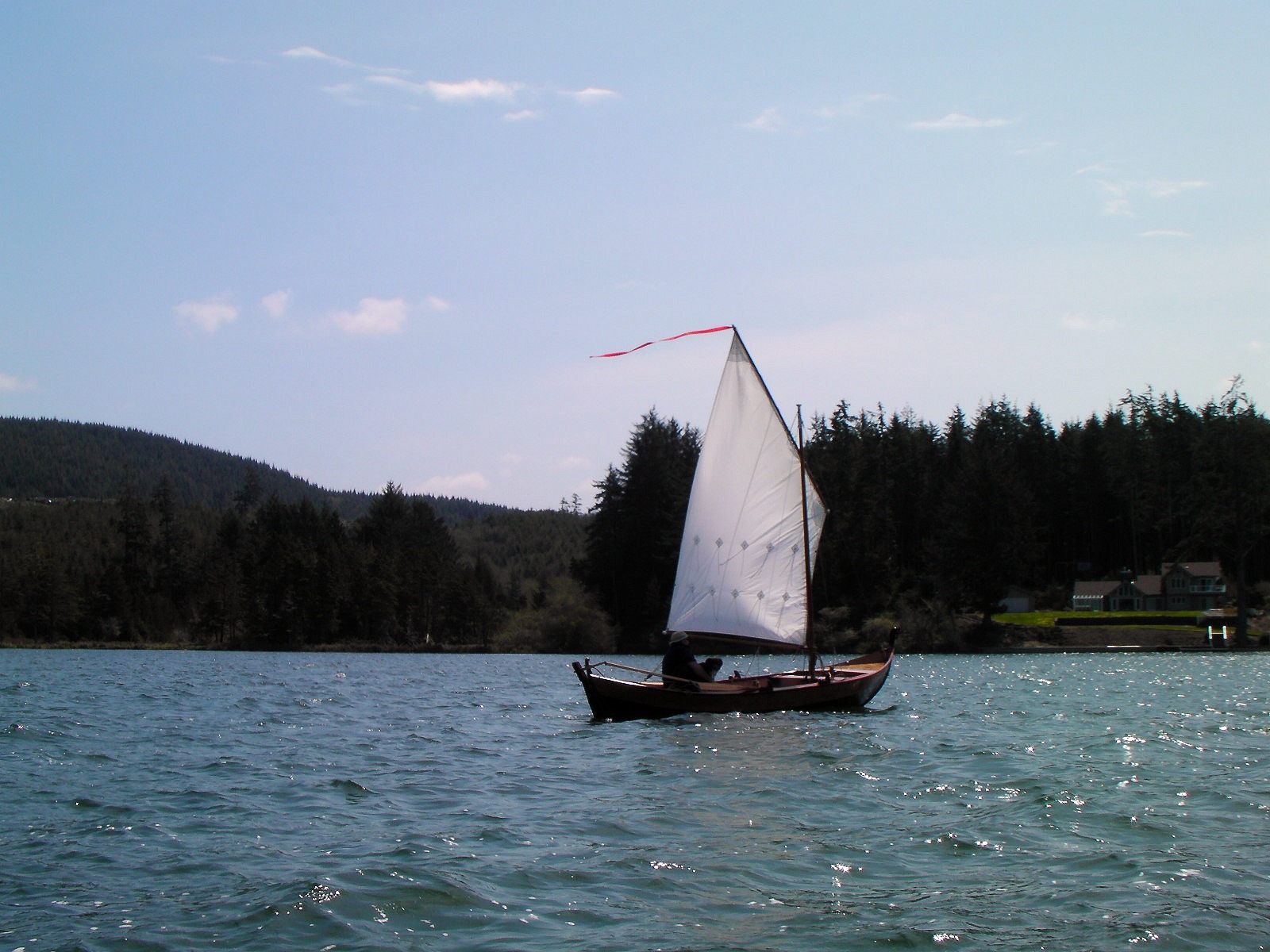
I need more tension on the luff, but it was my second sail.
Kelly, from Kerrville, Texas, is thinking about building a faering to sail and row primarily in a wide, deadwater river area with submerged cypress stumps. He wrote me with a couple of questions.

"I believe the length of Atkin's plan is preferable to 16'6'' in Oughtred's Elfyn design. However, Atkin's plan is described as finishing at 600 lbs.  Understanding that includes lead ballast, more meat in the keel, and so on, I'm concerned about draft.  Oughtred's plan says it finishes around 150 lbs."
A friend of mine, John Kohnen, told me Atkin said in one article the boat would weigh 600 pounds. In another he said it should weigh 450. I need to find a truck scale near a place with a boat ramp so I can weigh mine. My guess is that it would be closer to 450. Although I'm a belt and suspenders kind of builder who tends to overbuild things, I tried to rein myself in during Ravn's construction.

The design calls for 106 pounds of lead in the keel and I put in 98 pounds, according to my bathroom scale. I used purple heart wood for the keel, which is pretty heavy and with my tendency to overbuild, I thought I'd knock off a few pounds so I wouldn't come in too heavy. As far as I can tell, she floats right on her lines, so I think I succeeded.

I would not leave out the lead. The lines of the Valgerda are, according to Atkin, taken right off a Hardanger Fjord faering. Traditional boats built with modern methods (stitch and glue or glued lapstrake) usually end up lighter than the original. I think this would be true of Valgerda. If she didn't have the additional lead in the keel, you would have to add ballast inside to bring her down to her lines. I don't like the idea of lead pigs (or rocks) sliding around in the bilge. Were I to have inside ballast, I think I'd use sand bags, but that would be a hassle too.
I made the keel six inches shallower than on the plan making the draft about 12 inches instead of 18. I also gave her a little more skeg than Atkin drew. My reasons for these changes were these: I wanted shallower draft to make her easier to get on and off a trailer and because my primary cruising grounds include the beautiful coastal rivers of Oregon. The shallow bars require a shallow draft and good directional stability when you are on top of a wave (hence the increased skeg area). Beaching is easier too with less keel. Another possible advantage is a little less wetted surface, which would make her easier to row and may provide a little advantage in light air.

The only down side to the changes is that the deeper keel that Atkin drew should - theoretically - go to windward better. If you want a boat that you can tack upwind in a narrow channel, Valgerda is not your girl, even with the deeper keel configuration. In that situation, I drop the sail and row. That said, I am happy with my boat's windward performance: she is close winded, won't stall in a tack if you have enough way on and the right tension on the luff rope, and if she makes any leeway it's too little to notice.

An East Coast builder, Rick Nardone, built a Valgerda about the same time I built Ravn. He eliminated Atkin's fin keel too, opting to return to the more traditional faering keel, which is about four inches deep. His boat draws about 10 inches. Rick's been a real busy guy and I've only received one rowing report from him, so I don't know how she sails. That's another approach you might consider. (I think his boat may be for sale, by the way, if you want to skip the hassle of building a boat.)

I agree with you that Oughtred's faerings seem short. Modern Norwegian faerings are 18 or 19 feet long and the older ones, like the one buried with the Osberg ship, were more like 22 feet. Oughtred's  
Arctic Tern and Ness Yawl designs are the length I would consider, but there's something I really like about the three-strake faerings.

If, however, you decide you want something lighter or with a centerboard, by all means go with an Oughtred design. They are beautiful boats and, by all accounts, stellar performers. DO NOT put a centerboard in the Valgerda. I think that would really mess the boat up for little gain and a lot of unnecessary complication.
"Also, I'm curious as to whether or not you considered building in solid wood. After pursuing many boatbuilding sites now, I nearly have the impression that building a traditional craft in traditional style is less work than modern plywood and epoxy.  Not that simple, I'm sure."
By no means is building in solid timber easier. It takes more esoteric skill, is less forgiving and materials are harder to come by. (To build Valgerda, for instance, you would need board 22-inches wide and about 20 feet long for the mid-plank. Good luck finding that!) Then, once you have her built, the fun really begins. A traditionally-built faering needs to spend its life in the water or out of the sun and dry wind in a boat shed. Keeping a traditionally-built faering on a trailer - especially in a dry, hot place - would simply kill it.

Adrian Morgan, a boatbuilder in Scottland, built an all-wood version of one of Oughtred's faerings. Check out his blog and web site.
  
Now, about Kelly's shallow lake with sumps: I built my boat with just such conditions in mind. Where I sail there are lots of rocks just under the surface and plenty of deadheads too. I haven't had any collisions yet, but I put a double layer of 6-ounce fiberglass cloth below the waterline and built my keel and stems extra tough out of purple heart. I'm confident she could take a pretty good hit.
I don't think Kelly could go wrong with Valgerda or an Oughtred design. I told him another design he might consider is the Sellway-Fisher Kari 2.

The important thing is to build one. I hope I can post photos of his progress here soon. The world needs more faerings!

Friday, February 4, 2011

Other Valgerdas

Doryman's Valgerda at the Toledo Wooden Boat Show last August.

I correspond regularly with two other Valgerda owners - Doryman, who lives just down the coast, and Rick, who lives on the other coast - and I'd like to add to the list.

There must be more; the design has been around since 1952. John Kohnen snapped a few pictures of two different Valgerdas at recent Port Townsend Wooden Boat Festivals. I also saw one for sale on the East Coast a few years ago. It would be nice to have a list of builders, owners or former owners.

Heck, I'd even like to talk to folks who have just sailed or rowed one. Or even people who are thinking of building one.

I'd also like to talk to owners and builders of Kari 2, the Selway-Fisher faering of about the same size and style. I own a set of plans for this boat and almost built it, but the Atkin plan won out.

So, if you fit any of the above categories please let me know through the comment section of this blog. I would like this to be a place where we can share stories and ideas about this great design.

Rick's Valgerda

Sunday, September 5, 2010

Ravn's Rowing Report


Since launching Ravn Aug. 21 I've taken her rowing four times and I'm happy to report that, true to her Viking heritage, she handles like a dream under oars. There's no question that she has some weight when you take that first pull, but the extra glide seems to more than make up for it. She also just brushes off small waves.

The other thing I'm really pleased about is how stable she is. While rowing alone I used all of my 250 pounds to try and push the gunwale down at the middle of the boat. I didn't even get my knuckles wet. On another occasion I took my wife, daughter and her two kids rowing with me. At one point during the voyage four of the five of us were standing and moving about the boat; it didn't feel at all tippy. The grandkids had a ball running around on the boat.

When you look at the boat from the end it is narrow on the waterline, which makes it such a good pulling boat. She quickly gets beamier, however, as the boat heels or as the load increases, making her more stable. This bodes well for her being able to stand up under the press of sail.

I rowed across the lake near my home last Saturday when the wind was blowing about 15 knots creating some nasty wind chop. She didn't ship a drop of water and behaved herself like a lady, tracking straight and true. I decided to stop rowing and see what she would do. She slowly came to a stop and then clocked head to wind. I think that is the payoff for having a long, fairly deep (for a rowboat) keel.

While at the Toledo Wooden Boat Show, a fellow Coot loaned me two binders loaded with information on Scandinavian boats. It included a monograph on the Hardanger Faering by Owen H. Wicksteed prepared for the National Maritime Museum in Greenwich, London, copyright 1978. The author's family owned Kari, a Hardanger faering built in 1892. (I believe that this is the boat on which Paul Fisher based his Kari 2.) The oars used on the Kari were 10 feet, four inches long.

All the rowing I've done so far has been with a pair of 9-foot oars I borrowed from a friend. They move Ravn along just fine, but I feel the need for a little more leverage. I'm at work on a pair of 10-foot oars modeled after a pair of 8-foot Norwegian-made oars that are about 50 years old. They are beautifully made and have a nice shape. I'm excited to finish them and try them out.

One concern I had about Ravn was that she would be more difficult to launch and tow than my 14-foot Chamberlain dory. I need not have worried; even though Ravn is more than three times as heavy and has a deeper draft, it is not noticeably more difficult to launch, recover or tow than my little dory was.

Saturday, September 12, 2009

Valgerda or Kari?


The plans arrived from the Atkin Co. in November 2004. I had a lot of work to do to get my shop to where I could accommodate building a 19-foot boat and other projects that needed finishing. While I was working on those other things I studied the plans, built models of Valgerda and fretted about how I was going to build her.
Atkin designed Valgerda in 1952 taking the lines off of a faering imported from Norway. He praised the workmanship and design of the faering that was the inspiration for his design. The only thing he changed was the keel. He said: "I designed a new keel - the original boats had a long, shallow keel approximately 4 inches deep. When loaded, they had sufficient lateral plane to hold the little craft on the wind. With expert handling, they had little difficulty in reaching port." He drew a shallow ballast keel that housed 106 pounds of lead. The other change he suggested in building the faering was that marine plywood be used for the planking since 20-inch wide pine planks are hard to come by.
As my list of projects in the shop diminished, my doubts about whether I'd chosen the right design grew. Then I found another faering, this one was designed Selway-Fisher firm in England. The lines for this design were taken from a historic 1892 boat that now resides in a museum. It was designed for "stitch and glue" construction, which appealed to me also.
In the Selway-Fisher catalog it says of the Kari 2: "The original (was) built in 1892 for the sum of 70 Kroner (£3.10.0). The original is now in a museum and still in excellent condition, having been used by several generations for holidays and a few long expeditions. We have now taken the original lines and produced construction drawings for modern stitch and epoxy construction using plywood. The hull is a close resemblance of the original but we have given her a deeper keel to enhance her windward performance."
I ordered the plans for Kari 2 and they arrived in November 2006 and I built a model from the Selway-Fisher plans. The deeper keels on both Valgerda and Kari bothered me because it was a departure from the original faerings and because I felt I needed a boat with a shallower draft to explore the parts of the Oregon coast I yearned to go.
I decided to build my faering using the Atkin plans for Valgerda. Part of my decision was because I had a hard time wrapping my head around the metric measurements in the Selway-Fisher plans. But more than that Valgerda just appealed more to me ascetically.